
Weblog Commenting and Trackback by HaloScan.com rockpool in the kitchen

Wednesday, November 15, 2006

Biology

Granny cannot hear herself think. Damage on roof - and the sounds like camels and an elephant making it - is one thing; the sound of it being repaired is almost worse. (Electric drills, don't you know.) The roof is, obviously, very very thin. Complaining about the noise to Mr Handsome from Blackburn , asking for the work to be left till she is out, later, would not be politic on the whole. He is even thinner skinned than the roof. No wonder the roof springs its leaks every summer; as for the leaks Mr H springs when complained at, don't let's mention them. In any case the job has to be done. Of course it does; rain is threatened. If the boiler electrics are left uncovered, rain will short the whole house; electrics of which find themselves shorted often enough for much less obvious reasons, local electrics being what they are. (You think they are bad in Britain? You should try here.) But still, meantime, bang, bang, screech screech + (loud) groan (from granny.)

She had been going to continue with her translation of the excellent Spanish detective writer. But that requires close concentration and a clear head. Is it an insult to say she needs less for writing this? Possibly. On the other hand a leap out from rational thinking sometimes does wonders when it comes to banging out new prose. Wonders are needed on prosaic mornings - even with the help of coffee most mornings for Granny are prosaic and worse. Let's hope wonders come.

In any case Granny faces a disrupted day. Beloved has co-opted her to help with his AS level students. All of them have been brought up in this island. Not one of them seems to know anything about it - if she is being snobbish about these things she'll explain that they are mostly the children of British bar-owners; when the parents' thinking doesn't stray much beyond, sun, sand, beer, alcopops, chips and Traditional English Breakfast, what can you expect of their offspring? They have never been rock-pooling for instance; the sea for them means beaches and pulling each other; that kind of marine life. The often more interesting kind, creatures in, on, over and under the sea, don't figure to date, not for them. Beloved is determined to change this. Currently he is teaching them about the food chain; today he will introduce the food chain directly in a local context, via the salt flats down the road from Granny and his house. His job there will be to show what's in the sea, eating and being eaten; to point out the seaweed and samphire, covered and uncovered by the tides, twice each day; to help them catch animals, pull up seaweeds to install in the fish-tank/rock pool newly installed in the school biology lab. His job is not - he has decided- he hasn't the time - to introduce his pupils to what's above the sea, the top of the food chain, in this context. Namely wading birds and seabirds.

Guess whose job it is to introduce them? Granny has only herself to blame for getting herself landed with this. She likes birds, a lot. They give her acute pleasure sometimes, lift her heart. Doesn't she take and use her binoculars every time they go down to the salt flats - several times a week usually, to run the Beautiful Wimp and the Tiresome Terrier. She has always liked seabirds, especially; not least because even the smallest are not particularly little. She is very short-sighted - a fact discovered when she was eight years old. Her mother unfortunately fell for the Bates school of thinking espoused by Aldous Huxley - him of Eyeless in Gaza, Antic Hay and "Gumbril's Patent Small-Clothes" (very funny. at least she used to think so: she doesn't know if she'd find them funny now). His views on short sight were not so funny. They involved curing lazy eyes with extremely tedious, frequently repeated exercises; they involved not wearing glasses so as to make 'lazy' so-called eyes work harder. Between the ages of 8 and 12, consequently, just at the age when children learn, or should learn, to be observant, Granny went round in a fog the whole time, except when permitted to wear her black-rimmed NHS spectacles - at the cinema or the theatre, or looking at the blackboard at school. Out in the open air she never wore them She couldn't see sparrows or blue tits, except as blurs. She could see seagulls and herons, more or less. So there you go.

So perhaps she should blame her mother for inflicting this task on her. Or maybe the rather dishy oculist Granny used to be taken to see. Shame on her to think his dishiness might have influenced her virtuous (very) mother's thinking. Worse shame on everyone - not least Aldous Huxley - that the whole thing turned out to be codswallop. Granny suffered her blindness for nothing; which in the case of so many things, for so many people, is often the case.

'I'll show the kids what's in the water, we'll fish for shrimps, pick up snails etc,' Beloved said. 'You can go and look for birds. When you see some you can let me know, and I'll send the kids over in pairs. You can tell them the names and they can write them down.'

Excellent thinking, Beloved; except for two things:
1) Birds don't tend to stay in the same place. By the time her students arrive they will quite likely have scarpered - because of the kids' arrival, or her own moving or shouting, not least.
2) Although the salt flats are often full of birdlife, they aren't at the moment. Three weeks ago along with the ubiquitous egrets, of which there will still, most likely, be a few - she can point them out, make the kids look at their beaks through binoculars, explain how they feed - there were herons, whimbrels (small curlews), all kinds of big and little plovers, sanderlings, turnstones, terns as well as gulls. Oh, and a spoonbill. But then the rains came, the winds came, they scarpered. The lot of them, apart from those egrets. She can only hope they have returned today, some of them. Otherwise the only beaks they see will be those of gulls - scavengers, they don't feed directly on what's under under the sea - and of that odd egret, high stepping about like a little pony, snaking it's neck. Their notebooks will be full only with the names she gives them; they'll have to go back to school and look it all up in a book. Which is a pity.

Among the first years students, there will be a second year; the student - a boy - asked especially to be included. Beloved was pleased to see him so enthusiastic. But as soon as Mrs Jonah, the headmaster's wife, who is to help with the driving heard about the request she said; 'There'll be a girl involved. I bet you.'

Granny will be looking to see which pair of students arrives for her instruction hand in hand. That's real biology that is. Perhaps Beloved can add it to his instructions on food chains. Or perhaps not. Such things don't interest him. His idea of hell would be to be shut up in a room with nothing but volumes of agony aunt stuff, and the Mills and Boon backlist. It would be Granny's idea of hell, too - but not for the same reasons.

Labels:

Friday, July 21, 2006

moving furniture

One Sunday, not quite two weeks ago, Granny and Beloved Son took apart a chest of drawers and loaded it, with difficulty, into her car (actually Beloved's car; a substantial vehicle, no, not a Chelsea tractor, more modest than that, bought originally to transport such things as wheelchairs, and very useful for as long as it lasts - it's getting old - when moving house). She drove the assorted drawers, the wooden frame, from Kew to the Goldhawk Road and still with the help of Beloved Son took it up two flights in the rather basic lift of her block of still mostly council flats. Then they put it together again in a room in her new flat (which is not basic at all; with its two balconies and view of sky and trees, one minute away from busy streets, it was well worth the weeks of hassle to get it; worth all the packing, unpacking of boxes, tears dropping onto her possessions the while.)

This mahogany, elegant, almost certainly eighteenth century chest of drawers holds much emotional significance. She first encountered it in the early days of her ecstatic love-affair with her first true love, her first lover, her first husband, in the days of their ridiculous youth. It stood in his little room up a flight of very narrow stairs in the house on Richmond Green lived in by his parents. He had found it ruined in a junk shop, bought it for almost nothing and lovingly done it up; stripping it, re-polishing it, replacing its handles with authentic brass ones, finally cutting it neatly, beautifully, in half, because it could not, otherwise, be manoeuvred up the attic stairs to his room. It accompanied him and Granny throughout the days of their married life and stayed with her - she was glad about this - when that marriage fell apart. To this day she is grateful for its neat division; it has spared her removal men, men with vans, whatever, as on this so recent Sunday, making it light enough for her to manage herself, with a little help.

Granny’s son had a cup of tea and left. In the afternoon, Granny filled the chest with her clothes, crying a little with grief for the boy who rescued it fifty years or more ago. It has changed very little since those early, ecstatic days. There are a few more stains on top. A brass handle fell off, years ago, got lost in one move or another. Granny being less practical herself and surrounded by less practical people has replaced it with a scarf tied in a knot. Maybe in honour of her dead ex-husband, her long ago lost love, she will one day soon trek round the street in London – Percy Street is it? – where such things are still sold and get another authentic-looking brass handle and screw it on.

The chest brings back everything she ever loved about the father of her children and loves now in memory, in her grief at his sudden death. His weird and wild sense of humour; his love of birds - if she can distinguish the song of a blackbird from a thrush, if the swoopings and shrill callings of a flight of swifts turns her heart over to this day, she owes all that to him, who communicated his passion to her. She thinks with pleasure of his love of music, a love she did share from the start; but there are still pieces he introduced her to that she associates with him. Throughout the last few weeks there has run through her head an exquisite song asking the wistful question 'Bist Du Bei Mir?' which one summer afternoon, not long after they met, he played to her in his room at Oxford. Above all, perhaps, she loved his wonderful competence at such things as restoring chests of drawers, at carpentry of any kind, at all kinds of practical matters. Though his working-class mother had run off from his printer father long before, with a mad Catholic lawyer, though the family on Richmond Green lived an anything but working-class life, he had spent a lot of time as a child round uncles who earned their living with their hands and bodies and taught him how to use his too. In the world Granny grew up in boys didn't learn carpentry or even gardening. They learned Latin and how to play cricket. In the good days of her marriage, watching her husband tackle his garden, she contrasted the easy movements of his well-trained body with the awkward way the stockbrokers, accountants, lawyers in neighbouring gardens jabbed at their soil and loved him for it all the more. As she loved too the fact that unlike her, unlike any other men she has ever met, he taught himself as a teenager to operate a sewing-machine and make dolls’ clothes for his little sisters, without any of the ridiculous sense prevailing round the boys Granny knew before him that such activities would be shaming, to be left wholly to women.

The marriage couldn't last, despite the early passion, despite the children they had together that both Granny and their father loved. Granny and her husband were much too different to remain together permanently; as the years went on they made each other very unhappy. It was Granny, though, always the noisy one, the one who in her misery sometimes publicly disgraced herself, decided it could not go on; it was she who decided to leave, knowing as she did so that she would be the one therefore to take the flak. Though in the end they both found people more suited to them, who could make them truly happy, she still sometimes finds herself taking the flak: just a little; or feeling that she is, maybe not quite the same thing. But she can't complain really. Sigh as she might, she knows it was the price of things, the bargain she settled for. She knows that despite everything her decision was the right one.

The breakup happened more than thirty years ago now. But in the aftermath of his death it seemed like yesterday. She was taken aback by how raw and immediate both the good and the bad still felt; the love, the anger - the guilt – came up as powerful as ever. This was all the more so because, inevitably, the main family business, took place, had to take place elsewhere, round his new family. Granny felt deeply for his wife, his young daughter, theirs the true, the most awful kind of loss. She felt deeply for her children’s loss of their dad, a deep, unique grief of saying the last goodbye – so unexpected this time - to a parent. At the same time because the solace of the communal, shared, domestic grief was necessarily denied her, she was mostly thrown back on, left to centre too much on, her own pain, something not helpful to her or anyone else. It was another price she was bound to have to pay. From the support she has had from friends, acquaintances who've been through the same thing, she knows now how common such experiences are when a family has been divided in this way. ‘A pain like no other,' Pat of Past Imperfect called such deaths, in a comment on Granny's last post. Yes. But then major decisions, even the right ones, have their downside- go on having a downside – for all those involved for the rest of their lives. To resent, that, to continue wailing 'if only', is a waste of time. Years ago, after Granny's twin sister died, a friend said to her, 'When someone dies there is always unfinished business.' Yes. And the older you get, as more friends and family disappear, whatever the circumstances, the more you have to accept the truth of that. If with the odd, regretful, sigh.

This: on the other hand. What is it about Granny’s generation of women, many of them still her friends, mostly her oldest friends? None of the women are that old yet, none have reached their threescore and ten. Their husbands too, though older, have not, had not, attained the average age which men can now now hope to attain before they die. But of all those once golden lads, whether left long ago or more recently, or whether still married to their wives, all but one - and he is ill - are dead, leaving their no longer golden girls behind. What can Granny say about that? Not much. But it makes her mournful.

She is back on her island at the moment; it is its usual charmless summer self; windy, cloudy, up where she lives, dry, dry, dry, everywhere. At the same time it is very humid - just imagine this! - a place where, simultaneously, your garden dries up and your kitchen walls grow mould. She is harvesting her figs and making jam. For the moment that will do. As this piece will also have to do. Having posted it, she intends remaining silent for a little longer. Bear with her.

Labels:

Monday, February 27, 2006

Shelling peas

It has not been warm lately; the winds are cold. Think English June - sun coming and going - wind chilly - the shops full of young vegetables - green peas - salads - the first strawberries. That is how it is here now. Even though in the right place round the house, a sheltered enough place, the sun can be warmer than in England in June; certainly brighter; certainly stronger.

No problem about using only fruit and vegetables in season here! New green peas in February grown just round the corner/a few miles up country? Ditto strawberries? Granny up at the market on Saturday, the market where she acquires these lovely things, heard an Englishwoman in the queue ahead of her complaining; 'it's much pleasanter in England at this time of year.' By which she meant there's proper heating in the UK. She can't have meant the temperature outside - in the UK it has been below or at freezing for weeks as far as Granny can tell, this has removed any temptation she might have had to take a quick trip home. 'We had to put in a wood stove, ' the grumbler went on. Smug Granny thought - but didn't say - she'd had her own for years; some people take a long time learning. The woman went off with her bag of peas happily enough; she must have seen some advantages in living where she does.

So Granny sits outside in the sun, emptying her young pods, serenaded by courting sparrows. (Would you believe it, they not only fan out their tails, they almost sing, sweetly, not at all like the usual rough chirp chirp chirp. What love does - even for birds.) Shelling peas is a kind of ritual she remembers happily and painfully from her childhood. In the right season it was her mother's preferred way of having a talk with one or other of her daughters. Summoned, you would sit, the pair of you, in deck chairs, basket of pea-pods between you, alongside the bowl for the peas themselves. Both would be wearing those cotton skirts, gathered at the waist, voluminous enough to cover your splayed knees - was there anything ever more uncomfortable, more ungainly than a deck chair? - 'I can see all you've got, dear,' Granny's mum would joke if you didn't cover them well enough, quoting an old aunt. Not that she herself cared one jot. If it was warm enough, she would have stripped off the aertex shirt she, like Granny, would be wearing above their cotton skirts, to show the bra dyed pink, by now much faded, that she used as a bikini top; it sagged, it left nothing to the imagination whatever. On her other side would be set her ashtray, her lighter, her packet of cigarettes; always Player's Navy Cut, the one with the head of a bearded sailor peering out from a life belt. Granny thinks now that it reminded her of her dead ex-sailor father. That it was a kind of loyalty even. She never in her memory, never ever, swapped brands.

And there they would sit, their fingers stripping the pods as mechanically as if milking cows, discussing whatever it was, they'd come for. Only when the pods were all empty, the bowl of peas full would Granny's mother pick up Players Navy Cut, her lighter, light up. (She smoked always, inside the house and out - passive smoking unheard of then, Granny and her siblings must have breathed in a fair quota through their childhood. Their father also smoked, a pipe in his case filled with his own tobacco, grown down the garden, hung to dry first in the garage, then in the kitchen, on the clothes airer, then chopped up on the kitchen table and sprayed with some preservative or other. It smelt disgusting, but was very cheap. Granny's parents were always trying to save money in one way or another.)

Having grown up with the endless labour of war and post war grow-your- own, Granny was not tempted to self-subsistance Good Life later like many of her contemporaries. Hunting for hens with a torch in the middle of a rainy night? Picking brussel sprouts off frosted plants? Spending all of June, July, August head down in vegetable or strawberry beds, or inside a fruit cage picking raspberries of red currents or in the kitchen, processing them? No thanks. Down to the greengrocer for her.

Nonetheless shelling the peas from the market, picked almost certainly the very same morning, cooking them with a little mint, eating them slowly quite on their own, she is reminded of the unbelievable luxury of home-grown vegetables that she used to take for granted. A greedy child she looked for descriptions of food in the books she read endlessly. One was a much cut version of a nineteenth century classic called the Fairchild Family; an evangelical book in which children were taken to see corpses hanging on gibbets as a lesson in what would happen if they continued to quarrel among themselves. Such things had been cut from the illustrated edition Granny owned, handed down from her mother. Along with descriptions of believable naughtiness went descriptions of the food the family ate. Granny can't quote directly; the book is in London. But it went something like 'a roasted leg of lamb, new potatoes and green peas, and a redcurrant pie with cream.' You had to grow up with a vegetable garden to know exactly how perfect that could taste, simple as it was. Granny did know; she drooled over it. Read it again and again, like comfort food for when she was feeling sad.

Beloved daughter, or rather Beloved Daughter's Beloved Husband, does grow vegetables down his garden. Granny sometimes gets to taste those. Beloved Granddaughter alas, does not. She does not like vegetables - or fruit - much. What a waste.

Granny has been tagged by the way. She will attempt to answer the questions, slowly, over the coming week. Patience, Pat.
Patience.

Labels:

Tuesday, January 24, 2006

The story continues

But first, before anything let me point you all to the fact that my friend Caroline, of the wonderful Trivial Pursuit, has been nominated in the Australian/New Zealand section of the Bloggie awards. Visit her; read her; enjoy her. And ABOVE ALL VOTE FOR HER. Because you know - as I do - she's worth it.

Granny is boiling Seville oranges for marmalade. One of her favourite smells. On a wet and windy day in the Canary Islands it seems a comforting kind of activity. The rain over Granny's land is practically horizantal. Means more plants, though. Good. Only problem is that all rain here is like snow in England 'the wrong kind of rain.' System can't cope with it. Roads flood. (No gutters.) Roofs leak (no slope, no gutters.) Electricity shorts thereby cutting off phone water and God knows what else (no proper insulation.) This is not surprising. Rain used to be a much rarer event on this island. The very first time Granny visited it, over twenty years ago, was in the middle of a seven year drought. Even when she came to live here three years ago there was a good deal less rain than now. Plants, flowers, such as grew were low to the ground. These days, the wild marigolds covering her land have long stalks. Main disadvantage - apart from problems above - is that it is also much colder; currently 13 C up here - not much more inside house. Since the Spanish electricity company refuses to allow its Canarian branch greater capacity and since everybody is busy turning on the heaters, at night especially, and during fiestas even more so, Granny's electricity is always blowing. She has - quite illegally - managed to increase her allowance slightly, essential when there are paying guests all wanting showers, to use hair-dryers, not to die of cold. Even so, one appliance too many and darkness falls. Candles to hand in every room are essential. (On ecological grounds being so forced to limit use is A GOOD THING. But it's hard to be glad of virtue when shivering in the dark.)

More animals. (Sorry.) Currently a seven month old tabby kitten is acting as rather prickly neck-scarf. Her brother is yowling somewhere in background. (He's hungry; too bad. Lunchtime is some way off. ) Meet Feline Lorengar (she has the nicer voice) and Feline Manrique (he's prettier.) FH they aren't, but it is nice having healthy cats around after the misery of the last month or so with the ever sicker orange one. And kittens are always engaging - Granny is glad to see them developing their mouse-catching skills around stray pieces of paper, etc, though she'd rather they didn't do so on lurking pieces of crockery; much more breakable; at this very moment a loud crash. (Pause to pick up pieces; CURSES -one of Beloved's own creations; hide pieces; FAST.) A donkey as yet there isn't. The one on offer turned out to be an entire male; ie - to those of you need this further information on the genitals of the ass in question- ungelded. Liable to be noisy at the first sniff of a female, claimed Beloved. Not to mention obstreperous. Granny did go so far as to visit it. It did not seem obstreperous in the least - 'docil' she had been assured: more like 'dopy,' it turned out, or even depressed; it barely showed interest in the carrot thoughtfully provided by Beloved. Granny wondered if it had in fact been dosed with something to make it seem docile. Either way Beloved has given it the thumbs down. Good. Not so good is his mention of the noise made by donkey. This 'rural paradise' (sort-of) is supposed to be a haven of peace. But between two crowing cockerels, two yowling kittens, two barking dogs, and any moment now a braying donkey, quiet it isn't. Bring earplugs everyone. You'll need them.

Anyway it is now all, donkey-wise, up to Beloved. Granny has washed her hands of the matter. If Beloved he wants a donkey, let him have one. He can do the work! She'll confront the goat problem when it arrives. And not before.

She is reminded of her parents a little; also like Beloved full of wild schemes, though less likely than him to put them into action. The pig never arrived for instance. Nor the 14ft dinghy. (A bit difficult to manage that; the nearest water a muddy trickle called the River Darenth, good for sailing paper boats but not much else; the sea a two hour drive at least.) One that did come to fruition was Khaki Campbell ducks, which turned a large part of the garden into a sea of mud and produced eggs that noone would eat. Another time - this was a money-making scheme of which they had many, mostly ill-advised - came the idea of breeding standard poodle puppies.

Granny for her eighth birthday had been given the mother - the runt of a litter from a very pedigree mother, whose father it was reported had won the championship at Crufts. Since she had been the wrong shape, colour etc - the Kennel Club, wrecker of many breeds, were sniffy - she'd been handed over for free. This did not stop Granny's parents thinking they were onto a GOOD THING; as soon as she was old enough they introduced her to a suitably aristocratic mate. First litter, they thought. Two or three puppies, four at most. Sell them for a fat profit. MONEY. (Granny's parents always felt themselves poor; by middle-class standards they were; but not by anyone else's.)

Actually she produced eight. And did anyone want them? Does it need saying? NO! Standard poodles are large dogs; they eat a lot. This was at the time of meat rationing. And although horse meat on which the dogs were fed did not count it was not always easily come by and expensive. (Oh the sweet smell of it that used to float round the house when Granny's father boiled it; not as bad as his chicken food, but bad enough. Unlike the rest of the family, Granny's dad did not have a good sense of smell.) Had they been miniature or toy poodles the puppies would indeed have sold for good money; but they weren't miniature or toy poodles; far from it. Granny's parents managed to find homes for four of the puppies - but not for money; they had to be given away. Four of them stayed on, making five large dogs in all. Never mind, everyone said; they're nice - they were too, all different colours - champagne, orange, russet, black and a magical etherial silver, each lovingly named by Granny and her siblings -and all entertaining to boot. But oh the cost - oh the smell - of the ever-increasing quantities of horse meat. Which they didn't seem to think adequate, even so. Unbeknownst to the family they ganged-up, took themselves off and raided neighbouring chicken-runs - very crafty about it they were - one went inside, to chase the hens out, two caught them, one stood guard. The mother meantime sat helpless in the distance, clearly worried about the whole thing. The chicken owners protested. Some went to the police. The dogs' owner - Granny's dad, ended, inevitably, in the local magistrate's court.

After Granny's father died she found in the book of family clippings that, sweetly, lovingly, he kept all his family's life, a piece cut out of the Sevenoaks Chronicle, their local newspaper, detailing the case. 'It is not only human parents that have delinquent children..' it began. A large fine followed on top of costs, of reparations to chicken-owners etc etc, on top of the fortune on horse-meat. The dogs, apart from the mother, disappeared - the children were told that homes had been found for each of them after all; Granny wonders now if this was the whole truth; never mind. What was certain was that yet another money-spinner - not the first or last - turned out anything but. Her parents were like that.

Having grown up with such eccentricity, though, you can see why she loves her Beloved. Most of the time.

Labels:

Thursday, December 29, 2005

C--entimental K---hristmas

Christmas is an event which Granny experiences only in the brief intervals of loading - and subsequently unloading - the dishwasher. Or that's what it feels like.

It is an event that has two effects on her. It makes her sentimental on the one hand, and bad-tempered on the other. (See above.) Neither state of mind can you want to hear about. Never mind. You are about to.

The sentimentality starts as usual on Christmas Eve while she potters around the kitchen, doing this and that, and listening to the King's College Chapel Festival of Nine Lessons and Carols. At the very start of the soprano voice singing, solo, 'Once in David's City' the tears start rolling down her cheeks. Just as she knows they will. This is the time she remembers her mother, dead since Granny was 22, with whom she used to listen to this service so many years ago. Granny finds herself talking to her mother, throughout it: you can talk to the dead you know, you really can. Sometimes rudely. But not in this instance. Hence the tears. Along with them and the ghostly conversations come other thoughts, also sometimes tearful, of the many other people there are to remember as the years go by and this one or that disappears into the dark; some mourned, like her dad and her twin and some dear friends; some not. Sorry. She warned you she was sentimental at this time. It's the effect of getting old, you know. Of so much past, lost and gone for ever, just like darling Clementine. Amid the celebratory present.

Granny's Beloved does not care for either the music or the tears and makes sure to absent himself at this point as in every year Granny has spent with him. Talkative Irish visitor alas did not. (Talkative Irish visitor has been heard even when he thinks himself alone talking to inanimate objects; to his washing, for instance, as he hangs it on the line; 'hullo shirt, you look better than when I saw you last,' 'hullo underpants, you're all white now,' etc. So you see the problem. ) Granny managed to convey - politely she hopes - that this was a time for silence, and he too absented himself in due course.

There arrived, by email, these pictures of Beloved Daughter opening her Christmas present from Granny (silk from the Goldhawk Road as mentioned before) and of Gorgeous Eldest Granddaughter wearing hers (the black 'poor boy' cap, also aforementioned.) Followed shortly after by phone call from Beloved Daughter herself in which she announced that the whole family - that is her and her family, Beloved Son and his - were all coming to the island for Easter. Granny has some good Christmas presents. But this was the best by far. She wasn't crying now. She was laughing and jumping round her kitchen. Even having to load and empty the dishwasher yet another time seemed no hassle. Gorgeous Middle granddaughter - darling little schmoozer - announcing to Granny that her - Granny's present - was 'her best one' added to the delight, if Granny did take this one with a very large pinch of salt.

The (minor) disasters came as usual in threes. The door to the roof blew off. The window got stuck on open in Granny's car. (Electronic windows NO GOOD.) The bar carrying Granny's and Beloved's saucepans, garlic and chilli strings etc, decided that the large and very heavy Christmas jamon added to it was just too much and fell down with a crash - the jamon all but braining Beloved in the process. Felini Houdini knocked over a can of wood varnish in the office where he now sleeps, mixing it all up with his litter tray. She will say no more about this one, just leave you to imagine the horror. The horror. Actually that's four disasters not three. Never mind. Perhaps there are two more to follow, ushering in the new year. She hopes not.

Feline Houdini, by the way, has been announced CLEAR. No operation for him, though he still has to be fed for two months on food for diabetic geriatric cats, in relatively small quantities, pending more blood tests. This does not please him. Otherwise he has resumed normal activities. More or less. Yowling to go out at night etc. And sitting on Granny's lap in the evenings. Good.

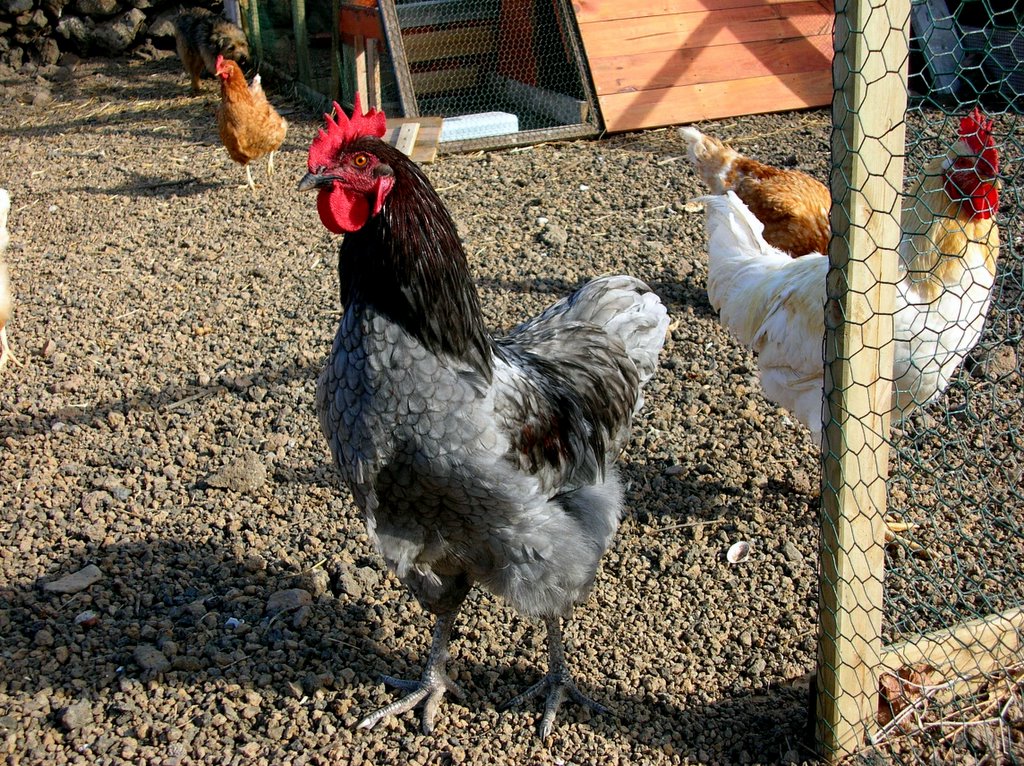
As for the chickens: Damien/Daphne has now started crowing, lustily, making it more likely he is all male. It is a very deep, almost tenor crowing, incidentally. Much more so than the original white cockerel, Colin. On the other hand, Colin still doesn't seem at all phased by him or visa versa. If Damien was only Damien, with no Daphne, wouldn't the two be fighting by now? This is odd. Also his bottom is still broad, more like a hen's and his tail feathers still vestigial. Here is a picture of Damien/Daphne; Colin is right behind him. So you see.
HAPPY NEW YEAR

Labels:

Friday, December 02, 2005

Really the Goldhawk Road...

Sun's out, sky clear, wind down. Only sign of almost hurricane now decimated plants.

So maybe Granny will at last regale you with the Goldhawk Road. She has a particular reason to do so, or will have in two days time. For which reason let's start at the posh end of Goldhawk Road, where it flanks Ravenscourt Park on one side and Stamford Brook/Chiswick on the other, before swinging round the corner, skirting Acton and heading for the much less salubrious delights of Shepherd's Bush.

Once upon a time, on the right- hand side of the road just up from Stamford Brook station, backing, almost, onto Ravenscourt Park was one of the bigger if not the biggest maternity hospitals in London, Queen Charlotte's. It's gone now. Queen Charlotte's has migrated to Chelsea, much less convenient for those locally pregnant. But when did the NHS ever set out to convenience anyone? (And no, it is not more convenient for pregnant Chelsea which had a perfectly good maternity service of its own up till then, but there you go.)

Granny has reason to be fond of Queen Charlotte's. It was there that Beloved Son was born, 40 years ago this Sunday. (If, reader, you dread reaching 40, think how much harder it is to to find yourself the mother of 40 year olds like Granny. Oh dear. Oh dear.) Granny wasn't quite so fond of Queen Charlotte's then as she is retrospectively. Queen Charlotte's though a good hospital was also a stuffy one. For her first baby, Granny had opted to patronise the Charing Cross Hospital (then situated in Charing Cross just opposite the station. It migrated to Hammersmith long since, wouldn't you know.) The Charing X was far from stuffy, attracting to its maternity ward an interesting mixture of local Soho cafe owners, of varied races on the one hand, and the more advanced middle-class with ideas considered outlandish anywhere else, on the other. This was due to its being the first hospital in London to offer classes in childbirth and to let fathers into the labour ward. Unfortunately all these benefits turned out redundant in Granny's case; she had to have an emergency caesarian, so did not need to use all those complicated breathing techniques she'd been practising for weeks; in mind and spirit she wasn't even present at the birth herself, any more than her husband was. Shame about that.

Second time round she determined to do better. Alas Charing X was not on offer; Queen Charlotte's was. When she demanded first maternity classes, and second, still more daringly, a husband at the birth she was invited bluntly to take herself elsewhere. But there wasn't a convenient elsewhere; she crumbled, acquiesced, though not before she'd been listed as a difficult patient. In practice things worked out better than she'd dared hope. Beloved son conveniently elected to be born on a Saturday when the labour ward was otherwise empty; when the dragons who kept the doors shut and husbands out were mainly off duty. Dear husband didn't quite make the birth - not least it happened very fast - but he was, against all the rules, allowed in straight afterwards, just as triumphant granny clutched her naked, bloody, but perfect baby to her bosom for the first time. There's nothing, she assures you, like seeing and feeling your baby born where previously you failed to , merely woke up with a slashed belly and a mysterious new being in a cot next to you. Weird that. In the case of Beloved Son she remembers the entire process; mysterious he wasn't.

The downside of its being Saturday and everyone off-duty was that noone was round to stitch her up. The dignity of the new mother was not an issue then. (She hopes it is now.) Granny's feet held up in stirrups, her very private parts were displayed in full towards the door. Anyone who peered in - many people seemed to - peered straight up her. She could have been furious about this. In retrospect she was/is. At the time clutching baby in one arm, then-beloved husband on the other, she didn't care a damn.

As usual things have changed since; not necessarily for the better. Home birth seems to be the main battleground now between the medical establishment and their more vocal patients. In the maternity ward itself the presence of the fathers is now so taken for granted it leads to quite other problems; such as fisticuffs arising between them and their mother-in-laws. Some hospitals - including the one where Beloved Eldest Grand-daughter was born - allow only one of them, not both, to attend the births. Forty years makes a lot of difference.

Enough of that; enough of the posh end of the Goldhawk Road; though Granny still thinks of it fondly and regrets the fancy and expensive housing which has replaced the site of her triumphant accouchement. Well beyond such things these days, her attention - and abode - has now moved to its other end; to the Shepherd's Bush Market and from thence under the railway bridge and on towards Shepherd's Bush Green, south of which is the little flat she inhabits when in London.

The market is one thing. In some respects it is a shadow of its former self, when the mere smell let alone the sight of it transported you to somewhere in the Developing World, a long way away from London. Even ten years ago the vegetable stalls stretched half way up towards the Uxbridge Road, you could buy huge bunches of coriander, basil, the kind come in mean little boxes in the supermarkets at 10 times the price. You could also buy any kind of vegetable just about; heaps of yams, plantains and so forth, not available anywhere else. The Grenadians who live in Acton all did their shopping there. They still do. If you want salt fish, ackee ackee, 'snail on stick' (a mysterious delicacy) black peas, etc etc, they are still sold in the dim shops that fill the railway arches. Most of the vegetable stalls, alas, have been replaced by those selling fallen-off-a lorry produce, mostly electronic. Though Granny does hope they haven't entirely chased away the knicker stalls offering a variety of highly-coloured, diaphanous, and vestigial garments. She hasn't visited lately on Saturday afternoons. But she hopes that the black limousines still draw up, that the flocks of ladies clad from head to foot in black, only their eyes showing over little leather masks, still emerge to surround the knicker stalls, rifling through their products, chattering away to each other. It always cheered - yet saddened - Granny to see that despite their enforced modesty they were allowed in private to be as frivolous as the rest of us. Yet frilly knickers seemed and seem a minor pleasure compared to the freedom to wander down the Goldhawk Road and up through the market unescorted, with the sun on your face and arms.

Beyond the railway bridge, the shops and restaurants lining the street up to Shepherd's Bush Green define the area pretty well. The nature of many is the reason this end of the Goldhawk Road makes Granny think not of Beloved Son, but Beloved Daughter. There are sundry greasy spoons of varying ethnicity - the Hot Pot for one offers Carribean breakfasts. There are dubious money changers, two pawn shops, beauty and hair salons and suppliers catering mostly for non-white hair and skin. There is the Pick n'Save Off licence, there are also a couple of wine bars for the Yuppies who live on the Hammersmith side of the road and a riotous Polish restaurant run by a former Polish opera-singer who throws vodka in the with fixed-price meal, overfills all plates with Polish dumplings and the like and won't take no for an answer. 'Eat it or else' is the rule of the place more or less.

But it is not these that bring to mind Beloved Daughter. What brings her to mind are all the textile shops. Beloved Daughter is a textile artist, decorating lengths of silk in abstract mostly geometric patterns, also cut from silk, to hang on walls. Granny is not describing what she does very well. It is hard to. It would be easier to show you the work but Beloved Daughter has forbidden Granny on pain of death - she means it - to show any of it on the Blog. 'Sooner put a picture of me' she says: - but she wouldn't like that much either. You will have to take Granny's word for it that they are beautiful; that she is as proud of her first child at this end of the Goldhawk Road as she is proud of her second at the other.

Two of the shops are for African textiles, mostly cotton or synthetic cloth with big, bold patterns. All the others are Asian: Alanita, Sikhur textiles, Orya, Unique Fabrics, Classic Textiles, A to 2 Fabrics, Flamingo Textiles, Arore Fabrics, and so it goes on; most of them have the name in Arabic script - Urdu - underneath. Granny has not entered all of them. But over the years she's visited many. When she can think of no other birthday or Christmas presents for Beloved Daughter beautiful - and expensive - lengths of silk are always welcome. She has learned to sweep past the outer parts of the shop where the sari lengths are made of cotton cloth or synthetics. 'I want the wedding saris,' she says; and there they are, Arabian night gleams of colour shimmering richly, in big bolts, ready to be measured out and cut by large pairs of scissors; if she can only choose which one. It takes hours to choose sometimes.

After such dazzlement by colour, she emerges blinking into the grey light of a winter day in the Goldhawk Road,where many of those thronging its pavements hailed orginally from no less sunny places than the cloth. Granny adores this mixture of people and places. It is one thing that keeps her in love with London. Much as she also craves the English countryside, she misses such a rich mix in country villages, surrounded by Anglo-Saxon pink-and-white. She misses it on her Canary Island. Though not as much as she misses Beloved Son and Daughter.

Forty years on, far from his birthplace down the smarter end of the Goldhawk Road, Granny wishes she could be in London on Sunday celebrating with Beloved Son and the rest of her immediate family the precious if messy if undignified moment of his birth.The telephone will have to do instead, alas. But it doesn't.

It is a truth, reader, universally known by mothers, but little acknowledged, that once your children grow up you spend too much of your life saying goodbye to them.

Labels:

Monday, November 07, 2005

Groan groan

It's been a long time since Granny's last post. Does anyone else find it as difficult as she does starting up again? She's been limbering up mentally for at least 24 hours, the pit in her stomach getting deeper and deeper at the prospect of finding something to say- on the one hand; or deciding where to start on the other. For here she has been gallivanting from one side of the world to the other, from south (southern hemisphere version) t0 north (ditto), from sub-tropic to tropical, soaking up early summer; and here she is returned to late-autumn-early-winter- firework-exploding-London. Less delicious in terms in climate, but full of people she loves, on the other hand, including her Beloved, just now, whose presence she rejoices in just as she mourns saying goodbye to equally beloved but irredemably Aussie Little Sister. For when will they meet again? Always the question. An Australian historian once wrote a book called 'The Tyranny of Distance'. Granny has never encountered a better way of describing how such far separation feels from one of those she loves best. It is probably - it is - naughty of her to find herself wishing one or two of other relations (she'll name no names) were that far off, rather than Little Sister. But alas, she does.

Little Sister of course may feel quite differently. And it is certainly true that she disappeared to Australia in her early twenties to get as far away as she could from a family that Granny is more than willing to admit - having spent two weeks in the company of two of its more difficult members - is not the easiest family to belong to. The pain and grief of the parents she has described before now cast long shadows over everyone; some, Little Sister for one, have learned to surmount them better than others. Granny's twin sister, the lightning conductor for all its griefs - isn't that true of most difficult families that someone plays that role? - surmounted them hardly at all. The sadness was passed down to her daughter Sad Niece; and by reflection on this holiday lain a little on Granny herself, conscious throughout how hard it was for Sad Niece to be surrounded by her mother's siblings, with only her mother missing.

She was more than conscious too that for Sad Niece, whose feelings for her aunt reflect more than a little of what she called her and her mother's love-hate relationship, the wrong twin survived the family lurgy. Granny herself could feel guilty about this if she let herself. Mostly she doesn't - what would be the point? For the duration though, the weight of twinship sat hard on her shoulders all over again. It always does sit somewhat on her shoulders; it always will; twins are physically part of each other, in death as in life, in ways it's probably hard for a non-twin to comprehend. Most of the time now Granny can and does forget the burden. Over the past two weeks, amid what was otherwise, mostly, delight, she has felt the weight again. She so wishes she could ease sad niece's sadness. But she of all people cannot. Little Sister, on the other hand, is in a better position to try and she will, she will. Lovely, beloved little sister.

Still if you have to be plunged back into family griefs, she can think of worse places than the Barrier Reef, or Sydney, one of her favourite cities on earth, come to that. Big Brother complained that the fish seen when snorkelling weren't so good as those in the Seychelles; he would. But even he admitted that the corals themselves were better than anywhere - and since these undersea gardens are what Granny herself loves best of all she was perfectly happy. As for little sister - she proved indefatigable, spending twice as long out there as anyone, and, for her efforts getting to swim with turtles. Granny saw plenty of turtles - and giant clams opening and shutting their jaws and smaller boring clams buried in rocks, but swim with turtles no. What she did see - and this was worth any other lack - was the members of her family, all different shapes and sizes, clad from head to foot in purple lycra, the suits designed to protect snorkellers and swimmers from the lethal jellyfish which start infesting these water around this time of year. She'd have gone still further than she had to for the pleasure of seeing Big Brother in such gear. Infinitely preferable she thought to his Old Etonian tie and blazer, sported for the family wedding.

Maybe her family were equally if secretly delighted - very tactful her family- to see Granny herself in the full glory of her Mastectomy Fashion swimsuit. Not least because she didn't work out till towards the end of the week how to anchor her false sponge tit within it. At times it lurked under her armpit; at other times hovered round her belly. Some of you may know Michael Ondatjee's description of his grandmother - the first woman in Sri Lanka to have a mastectomy - whose false tits similarly lurked in all the wrong parts of her anatomy and sometimes turned up in odd places round the house much to the bafflement of the family servants. The last one finally disappeared in mysterious circumstances; 'most believed it had been forgotten after a romantic assignation in Trincomalee with a man who may or may not have been in the cabinet...' Thanks to Beloved, Granny is a virtuous woman these days, she's unlikely to equal that. (She can, on the other hand, direct you urgently to the book from which that gem came, Ondatee's delightful memoir 'Running in the Family. ' A book she infinitely prefers to 'The English Patient.' But maybe that's just her.)

She and sad niece also had a lovely - even niece and aunt bonding day - out on safari with an ageing hippy guide and a nice if monochrome female Canadian judge, veering between rain forest and beaches which looked like what tourist brochures try to make beaches look like, but which in reality rarely are - miles of empty white sand, fringed with mangroves and palm trees. Idyllic. That is if you leave out of account the beginning to arrive jellyfish, meriting urgent warnings and supplies of vinegar on all paths leading out onto the inviting sands. Another version of the serpent in Eden no doubt. (But only between November and April.)

So that was the Barrier Reef. Sydney was something else; no time for that now - and anyway it was standard tourist stuff - a ride in on the Manley Ferry - towards the Opera House sailing across the sea. What was not standard was an entirely delightful lunch with another blogger, Ovagirl, the first of her blogging friends that Granny has met. Ovagirl herself has described this better than Granny could; so she will end by referring you here.

Labels:

Sunday, October 23, 2005

Brides, Birds and Melatonin

Granny two days in is not the least jet-lagged. Hail to the wonders of the - in England - unobtainable hormone, Melatonin, in this case snaffled from Beloved Son. She is however a little overhung and weary from yesterday's wedding - which started at 2.30pm and ended at 11pm, boozy throughout. And on a beach - really. Poor bridegroom had stinking cold, which poor bride might come out with on honeymoon. Otherwise a good time was had by all. Though Granny is wondering whether an entire week closeted on the Barrier Reef with her family isn't going to have its trying moments.

Her family, she'd better explain, politically and socially covers pretty much the entire English class system. Her far left twin sister ended her life living in a farm-labourers cottage with a cowman husband. Her middling left little sister is - she proclaims - 'a suburban Sydney housewife and proud of it' (and so she should be; she is altogether lovely.) Granny herself is also somewhat leftish and belongs roughly she supposes to what are called 'the chattering classes' - ie the gabby people in the middle. Big brother on the other hand is life-long Tory, home-counties, and something of a blimp. Granny thinks she may have some trouble buttoning her lip for an entire week while he goes on about asylum seekers. Etc. He's too like her dad for one thing; she never entirely learned to button her lip with him. It's amazing how the rebellious adolescent continues to lurk in the 60 0dd year old. Her brother doesn't arouse quite the same amount of emotion - but it's there, it's there. As indeed her dead twin's rather sad daughter, also part of the family party is too like her mother for Granny's comfort. 'My mother and my aunt,' proclaimed sad niece in a bibulous moment. 'had a love-hate relationship.' Ouch. But only too true. They were twins and it happens.

Granny loves her family all of them; really. But oh the echoes, the echoes.

About Australia on the other hand she is quite unequivocal. She arrived here first 27 or so years ago, almost by accident and not enthusiastically. But fell in love with it straight away. A feeling renewing itself fast. The birds, the wonderful birds. The family spent two nights between creek and beach in a rented beach house. Next door a woman was feeding five kookaburras on her balcony at 7am. There were swamp hens on the lawn, flying overhead from one bit of bush to another went white cockatoos, rosellas, lorekeets, magpies, goodness knows what else. The noise was extraordinary. As it is extraordinary here, back in suburban Sydney. An English garden by comparison is like an Anglican parish church with a choir of piping trebles, all very decorous. Whereas an Aussie one - think a sonorous Russian cathedral taken over by a cacophony of charismatics all speaking in tongues, raucous, mellifluous, strident, everything you can think of but all loud and all out of time and tune. Decorous it isn't. But fabulous. FABULOUS. Happy Granny.

Beloved little - but not so little - sister says raucous Australian birds are just like Australians. She is one, by the way, so can afford that remark. Granny's not sure she can; she's just reporting it. Please note. And anyway she likes Australians. Almost as much as she likes their birds.

Labels:

Monday, August 29, 2005

angry granny

Tony Blair as frightener of little girls? Yes. Admittedly, he is not one of those leaders (Granny won't name them) who believes in arresting his subjects arbitrarily and mistreating them - not if you're not a Muslim preacher anyway - or in some way the wrong kind of Muslim - most likely he does not allow the torture even of those; unless he exports them to a foreign country which has less friendly habits; whereupon he can pretend it isn't his fault, is it? Just as he has been proclaiming that the appearance of our local suicide bombers isn't his fault either; that his foreign policy in general, Iraq in particular, has nothing to do with the case. Well, the lead article in the Observer yesterday gives the lie to that. The Foreign Office have been warning him for a year of its effect on young Muslims. All of which got left out of officially published reports on improving relations with the Muslim community. Of course.

Granny took beloved eldest granddaughter out for the day on Saturday. It was a perfect day in every respect except one; what granddaughters and grandmothers are FOR, granny thinks. And no she does not mean the slight altercation over the Brie sandwich at lunchtime - the bread had to be exchanged with the bread that arrived with Granny's spinach soup, uncontaminated by rocket leaves and chilli-tomato chutney - they have smart sandwiches in the Tate these days. As Granny scraped the offending items off the cheese itself she exchanged sympathetic glances with the man at the next table engaged in a discussion with similarly aged young as to whether the artichoke in the pasta salad would have made the whole thing taste of it....growl - oh for the days of British rail sandwiches/meat and two veg and 'eat it all up or else' - well, maybe not. Anyway that was not the problem. Any more than the pictures of Frida Kahlo were - wonderful - 'but some of them are so much smaller than I expected,' said Granddaughter - they were too, but this did not least diminish the equally enhanced power of them seen in the as it were flesh. Nor was the wait for the bus to the Albert Hall (long) before the prom, or the not short attempt to catch a taxi from others taller and louder after. And the concert certainly was not the problem, despite the 45 minutes of its second half, devoted to Rimsky-Korsakov's Sheherezade - a certain amount of wriggling went on but it did not reduce the enjoyment. Granddaughter refused to leave till the very last encore had been played. The day was a big success. Granny enjoyed it anyway. She has every impression Granddaughter did too, seeing the intensity with which she looked at the pictures, the grin of pleasure when brass and percussion erupted in full voice.

The only problem was the one admitted to Beloved Daughter - Granddaughter's mother - the next morning. 'I was frightened going on the tube.'

Thankyou, Tony.

Labels:

Friday, June 24, 2005

Dead mothers; grieving children

It’s not just the sins of the fathers that get visited on following generations. In Granny’s experience, the deaths of the mothers are dumped on them still harder.

In previous generation this was of course much more common than now. Before the twentieth century few women lived long enough to be grandmothers. Too many of them died in childbirth, or else worn out by overwork. But Granny’s family has seen the story persist.

About one early death she only learned recently, with the help of the internet and the British Library. That is the death of her great grandmother, Frances, aged 31, when her grandmother was only 9. (Frances had lost her mother, aged 48, eight years before – but at least she was more or less grown up by then, unlike her younger sisters. But that is another story.) The reason Granny knew so little about any of this – till her research she did not even know her great grandmother’s name – was that her grandfather – Granny’s great grandfather – took a second wife, an American called Betty, who did her best to obliterate the previous marriage and its one offspring, Granny’s grandmother. After her stepdaughter’s death she even succeeded in persuading her husband to remove the equal billing given, in his will, to his son by her and the daughter from his first marriage – and, after her death, to her children, his grandchildren, Granny’s mother and aunt. (But for that Granny's mother would have been a rich woman; so might she be; richer anyway. Not that it matters.)

The American did more than that. Granny’s great grandfather was a notable enough man - an MP, among other things. Finding him in the records is not difficult. Yet not one of them refers to his first marriage, to his daughter, let alone to his descendents by her, only to his second wife and her son and granddaughter. (This son, Granny, must add, paid her mother’s wedding. Big deal. Charity to a poor relation, who, but for his mother, wouldn’t have been.)

How to obliterate women from history in one easy lesson.

Her mother hated her American step-grandmother – and not simply for this. She seems to have been an unpleasant woman altogether. But she did tell Granny one astonishing fact about her; that she NEVER IN HER WHOLE LIFE WASHED HER HAIR. Instead, every night and every morning, for half an hour, she had it brushed by her maid, thereby saving a great deal on soap (shampoo didn’t exist then.) The hair-brushing maid would have had the job anyway. She would have been paid a lot less no doubt than we spend on our hair now. Still, reader; take this advice. If you want to save on the wages of the maid, let alone on the stuff that can give you more than one orgasm if you use it right (according to one recent commercial)BRUSH YOUR OWN HAIR HALF AN HOUR EVERY MORNING AND EVERY NIGHT.

(It is too late for Granny to act on her own advice. As the man who has cut her hair for more than fifteen years suggests, delicately, her hair has aged along with her; it is no longer so straight or dark or thick, the natural reddish tints have all gone. Some grey has crept in even if brown still predominates. Even if she cheats and paints most of the grey out one way or another. Oh the glory days; gone without her realising that they had, for her hair, been glory days. It is cut short now. She will stick with Herbal Hair Health: or whatever it is called; even though she doubts if it will have the same effect on her as the young woman in the commercial. Those glory days too are not quite what they were. As for her step-great grandmother – she’s long dead; she has no idea if her hair retained its youth the better with all that brushing.)

Still, retrospectively, she mourns for her grandmother, made motherless, aged 9. By 1891 according to that year's census, she has been banished, aged 14 to a boarding establishment in Brighton run by three spinster sisters who gave her a no doubt genteel education – sewing and a little French – along with 15 girls of a similar age. Her father, stepmother and infant half-brother lived an hour or so’s coach drive away. Clearly she was not wanted. What happened to her between then and her marriage in 1904 aged 27, Granny has not been able to establish. Nor probably will she ever be able to. All she has of her from that time is a portrait painted of her in her early 20's, wearing a blue-green dress and looking ridiculously young for a grandmother, which still hangs on her own wall. (This picture went to Granny's sister in Australia for a while. The Australian customs, told it was a picture of her grandmother, lost it for several weeks; 'it doesn't look like a grandmother,' they protested. They are not the only people to forget that all grandmothers were once young women,)

Granny does know what happened to her grandmother after. Happily married to a naval officer, living in a naval town, she gave birth to little two little girls. From then on ‘Mother’ is the only name she allows herself in the captions to family photos. This is the more ironic in that she only was a mother for six years. Aged 36, pregnant with her third child she fell downstairs and died along with the baby - a longed for son. Granny’s mother was 3 and her elder sister 6 at the time. The carefully kept albums of their childhood end abruptly in blank pages. More motherless children. It goes on.

It's a bit like watching a tragedy on stage. You know the inevitable ending - yet still you find yourself saying under your breath, 'Desdemona don't drop the handkerchief...' When Granny thinks of her grandmother she sees her at the top of the stairs - transposed to the little house with a very steep staircase that she once lived in herself. 'Don't fall,' she hisses to her grandmother. 'Keep your footing, LIVE.' All in vain, obviously. She often wonders what her family's life have been had her grandmother not slipped that day. Granny herself wouldn't be here most likely. She doesn't know for sure if that's any consolation. For her mother and grandmother most probably not. As for the baby - he'd have been just the age to be sent to fight in the second world war. Maybe he was better off then. Or maybe not.

Labels:

Sunday, April 24, 2005

Aha: pictures


This is the very slightly less stupendously ugly 30's house into which Granny's family moved, the same year that the last picture was taken. (To be explained shortly.) It was the first house the family ever owned. Along with all the other pieces of Victorian baggage carried by Granny's father was the one that said 'Never borrow. Owing money is dangerous.' Something like that, anyway. So if you weren't lucky enough to inherit a family mansion - not always an advantage at the time; keeping them up became almost impossible postwar unless you also inherited scads of family money - and not always then - you rented. 'Mortgages' were invented by those friendly society/ building societies, located in the benighted north for the benefit of thrifty working and lower-middle classes. Classified as 'borrowing' they were not, NOT, utilised by southern gentry, like Granny's parents.

By the early 50's though reality had begun to kick in, even for financial, and relatively - in middle class terms - impoverished people like them. In the year of the coronation they vacated their rented 30's house, took out a mortgage and purchased this one. Where they lived until Granny's mother died. You can just see the rose garden in front where her father, a few years later, delivered his ultimatum to her Tribune reading boyfriend.

So to that picture; velvet kneebreaches, sword, tiara and all...... It was taken at 6 o'clock in the morning outside the palace of Westminster on June ?2nd (or was it the 3rd) 1953, the day of the Queen's coronation - and also, coincidentally, the day Edmund Hillary and Sherpa Tensing climbed Everest, for the first time. A happy coincidence possibly. Or maybe not. (Neither of the pair were English, in spite of an Englishman, John Hunt, having led the expedition. This fact was not emphasized in the triumphant reports.) As a result of his clerk's job in the House of Commons, Granny's dad, along with his colleagues, was required to act as an usher inside Westminster Abbey, hences the kneebreaches and the sword. 'Usher' was, he said, afterwards, a grand word for lavatory attendent; he spent most of the day escorting ermine-clad elderly peers with prostrate problems to the loo. Even had he known how to use his sword it would not have availed him much in such a duty; unless they'd gone out in herds perhaps, when he could have used it to prod them like cattle? Dream on.

Granny's mother, meanwhile, as his wife, was given a seat in the Abbey. The downside of which was having to present herself along with him - she was no more an early-morning person than Granny. This was why she stood there in that picture, at 6 a.m, clad in her one and only evening dress (New Look you may or may not have noticed) and the hideous family tiara, kept normally in a bank vault - where it is still as far as Granny knows: the uses of a tiara these days, are limited. Thus she did see Queen without crown, but with large train of attendents processing up the aisle past her, did see her again a few hours later, escorted back down it, crown and all. She did hear the miked voices of the priests, the Archbishop, the thin small voice of the Queen, sounding pretty much like Celia Johnson in 'Brief Encounter' as she made her vows, she did hear the great shouts of Vivat Regina, the soaring notes of Zadok the Priest fly up into the abbey roof above her. But given the large screen between nave and chancel - only the ultra-privileged sat there - she saw nothing of the procedures in front of the altar. For that she had to wait for the film just like the rest of us. (The special blue velvet stools on which she and Granny's father knelt at appropriate moments remained the property thereafter of those who used them. They kicked around the family house for years. It's possible Granny's brother still has them.)

As for Granny and her siblings; as the family of an employee of the House of Commons, they were given seats in a specially erected stand outside New Palace Yard. Escorted by an obliging neighbour - not unnaturally she jumped at the chance - they watched the processions go past, before the Queen was crowned and after. The Queen of course was in her golden coach, much like Cinderella's coach in the pictures, Granny thought - though Cinderella's headgear was prettier. But that was the only part of the procession just as it should have been.

It rained non-stop. The big black busbies of the soldiers had to be covered, so did their scarlet uniforms. All the royals, all the foreign notables, went past hidden inside their carriages, reluctant to ruin their finery by opening up the covers. All except the Queen of Tonga, of course, adored by the British forever after. How the British do love 'a good sport' even if fat, black and a 'native' . Granny did wonder who dried out the Queen of Tonga thereafter. Granny's Dad? But actually she may only have been so rash as to soak herself on the way back from the Abbey. Granny doesn't remember.

She did write a piece for the school magazine about the adventure. She only remembers one sentence from it; about the new silver carriages on the underground train they took from Charing Cross station to Westminster. 'They seemed right for the day,' she wrote. Something she remembers whenever she rides on one now, dull, not shiny, dented, covered in the shadows of ill-rubbed-off graffiti.

PS. The first post about her parent's griefs is almost ready. Granny will post it later today or tomorrow before she leaves for Blighty. Can you wait?

Labels:

Saturday, April 23, 2005

Sex and the single silk worm

Granny's still working on her parents. In betweenwhiles a small story about eldest granddaughter.

Like all children of her generation she's skilled on a computer; is allowed by her parents to spend half an hour a day on the family machine. (And no, it is not in her bedroom. Absolutely not.) One day recently she went up to have her session - the computer sits in her parents' shared workroom at the top of the three storied house. Only to come tearing downstairs suddenly pink-cheeked, demanding to be taken to the park on her bicycle - as she is not usually by choice a physically energetic child this was very unusual. Her parents were baffled.

When they used the computer later the answer to the mystery was obvious. Those things that appear like maggots when one bluebottle has landed popped up all over the place. Evidently their Gorgeous Daughter had googled SEX and got more than she bargained for. Beloved daughter said; I was expecting these problems in due course; but not at eight.'

Where was 'parental control' you might ask? Well, leaving aside her mother's belief stated above, Beloved Son-in-Law pointed out that if you impose this it disables all kinds of quite innocent and useful sites at the same time - he preferred to deal with the problem locally as far as he could. He proceeded to do so. Now if you put SEX into their Google it comes up with such gems as 'gender selection in fruit flies.' Or 'sex ratios in rabbits.' Granny is making these up of course. But you get the picture.

When Granny was eight she didn't know the word sex in any context other, just possibly, than that of telling the gender of her dog's puppies. Her parents meanwhile knew as little about such knotty problems as 'gender selection in fruit flies' - let alone 'ex ratios in rabbits.' Science was - and remained - as closed a book to them as sex was - but not for ever -to their daughters.

They did know on the other hand about silkworms. Granny has not a clue herself as to what whim led her mother to decide that her children needed to know about the life cycle of the butterfly/moth genus. Or quite how she managed to persuade the nearest silkworm farm - the onlyEnglish silkworm farm of which Granny knows - the one that still produces silk for royal wedding-dresses - to provide her with some eggs. Or how she managed to pick them up even - this was just after the war; there was still no petrol for their car. But she did manage all of it. As she also managed to browbeat the owners of the only local mulberry tree into letting her pick mulberry leaves to feed them on.

It only lasted a year or so, till the time, more or less, that the family moved to the stupendously ugly but much more comfortable thirties house in which they lived for the next six years. But Granny remembers it all as wondrous. Though it taught her nothing about sex - it wasn't intended to - the life-cycle of the silkworm moth sits deep in her soul somewhere. Some time she might try to describe it. But just now she has to take Feline Houdini to the vet to get 'sus protecciones.' In other words his yearly jabs. Cheers

Here is a small postscript added later: driving down south to the vet, loudly protesting Feline Houdini beside her, granny found herself reflecting; that her eight year old innocence was infinitely preferable to Beloved Granddaughter's so rudely disrupted one. She would not have wished that on any grandchild of hers - or anyone else's. Why does not Google, she wonders, prevent such sites appearing instantly to anyone? For those desperately in need of them - poor things - there would always be some way round it. Or is she just being naive?

Driving back north, Feline Houdini protesting loudly as ever, she reflected further on the fact that it was hot down there in the south, also seething with tourists. The price of her disdain for the latter, her somewhat guilty ambivalence towards her holidaying compatriots - their carefully chosen pastel holiday outfits, their peeling skin, the over-exposed, over-endowed flesh - is living up here with the wind; and with - at this time of year - the frequently immovable cloud cap above their heads. It is infinitely more beautiful in these parts, for sure. She doesn't really regret it, even while throwing on the sweaters. But she does sometimes wonder about the way she sees her fellow Brits, she really does - though she doesn't think she's alone in it.

After writing which she looks out of the window and sees the sky is blue and the sun has at last come out. She's off!

Labels:

Friday, April 22, 2005

Geometry


No: you are not seeing things. Granny's dad IS wearing kneebreeches and that IS a sword by his side. (Granny doubts if he had a clue how to use it.) Granny's mother IS wearing a tiara. Why? AHA. In this post - till the next maybe - Granny will not even reveal the date - it might give things away. All she will tell you is that his very much less formal attire that can be glimpsed in the fragment of photo alongside had been donned for painting scenery for the local amateur dramatic society. For the rest: AHA again. WAIT AND SEE.


Attic Woman aka the first Mrs R , latches on to words sometimes and then brings them up again and again. On Granny’s visit to her yesterday she said ‘It’s a triangle.’ She kept on saying it in one context or another, making clear that what she meant was the three of them, the first and second Mrs R and their Beloved. She seemed alright about it. 'I don't mind,' she said, Granny told her the story of her headmistress from the last post. Mrs R laughed furiously and then said ‘triangle’ again. And she and Granny held hands for a bit until the sun went in and it was time for her to be wheeled home.

Emotional triangles; yes. Granny has experienced one or two, who hasn't. Two women, one man. Two men, one woman. Not till she was an adult though – sometimes wishing she wasn’t - these are always uncomfortable and often painful situations. ‘There were always three in our marriage.’ Guess who said THAT’ Or more or less; granny is not going to chase up the original. But she imagines such triangles can be as uncomfortable and painful when polygamy is permitted rather than implicit. Her parents were, contrariwise, fiercely monogamous. When her dad remarried after her mother’s death, it stayed that way. Weeping after Granny’s stepmother’s death he said he felt bad about having stayed more devoted to his first wife. But he was a much better husband to his second wife than her first had been. She loved him dearly, he loved her too in his way and they spent twenty happy years together. Her death devastated him.

At his 75th birthday party – stepmother was too far up the table to hear, the naughty doctor’s wife leaned across to a startled Granny and said ‘I always felt sorry for you children. Your parents were so ridiculously over in love.’

This was the first time it had occurred to Granny that her parents’ mutual adoration could have been a problem. The moment she thought about it though, she began to understand what the doctor’s wife had meant.

In one sense her parents’ devotion was beautiful to be around and she’s still grateful for it. One of her friends – daughter of a far from devoted couple – claimed never to have forgotten the morning she and Granny came down to breakfast and innocently ate the bowl of wild strawberries Granny’s dad had picked especially for his wife; the fury that followed. (As the same friend has also not forgotten the time she was offered a drink and asked for whisky. Granny’s dad frowned at this – but because she was a visitor complied. Not so when Granny did likewise. Shouting ‘No daughter of mine’ etc, he handed over a glass of sherry. Young women it seemed – even older ones like Granny’s mother – drank sherry; or at the very most pink gin. Whisky was for men. Or grandmothers. Only later did Granny learn that her grandmother, his mother, kept a flask of whisky in her handbag and added goodly drams to her milkless cuppas.)

The doctor's wife comment did, however, make Granny realise the extent to which none of her parent’s four children existed in their own right. They were more an extension of the great love between them – an attempt by each of them to make up to the other for their own damaged childhoods. Granny and her siblings lived on their behalf the happily childish lives not given them: protected from the world the way they weren’t, despite a mutually abiding innocence.

The fifties were a time, anyway, when many middle-class adults tried desperately to put the horrors of the war behind the themselves and still more their young. Whispers of the worst horrors – Auschwitz, Belsen, Nagasaki - crept in; but still middle-class childhood was as enclosed as a hen-run, with anodyne children’s books to match. Even the war memoirs and stories that filled their houses like most and were read avidly by Granny were as remote as fairy-tales; gave her nightmares for a day or two, then vanished into the never-really-was, or at least could- never - happen-again. Much like the Dennis Wheatley stories of devil worship which she devoured (secretly) at the same time. She and her siblings remained wrapped in deep, terrifying innocence, even after they came across – as Granny did - such headlines as ‘H-Bomb exploded’ in the school common-room copy of the Times. Though she never felt wholly easy therefter, the innocence lived on.

It was pure Enid Blyton– there they were roaming freely across the countryside during the holidays just like the Famous Five - complete with dog if not the lurking crooks all ready to be foiled. In termtime – after the age of twelve for the girls – eight for their more unfortunate brother -they departed to boarding-school, their versions of St Clare's or Malory Towers. (Better than the descendents of Tom Brown's Rugby as suffered by the boys, for sure.) This greatly grieved Granny’s mother. She hated it every time - confessed later that she cried for two days. But because it was good for her children - she thought – she accepted it. Even despite the heart-breaking letters that arrived from her eight-year old son when he first went away. ‘I am homsick and lonly. Let me com home.’

But he had to learn to be an Englishman, she knew - Granny’s dad believed it so she had to -away from the softening influence of his mother. The theory in general was that children went to boarding-school to learn how to be independent. But actually all they did was learn how to survive in boarding-school. Not a good training for real life, if sometimes enjoyable at the time. (Granny’s dad taken in his nineties to watch his old school play another one at cricket reported with pride. ‘We won.’ Even though by now the school in question contained as little of him and what he’d experienced in it as his endless regenerating – and by now withering away - skin and flesh and bone contained of his thirteen to eighteen year old self. Very touching but sad. So you see. )

When Granny and her siblings went their own ways, still more when their lives took turns their parents found difficult to encompass, it was as if they were losing parts of themselves. Granny’s nurse sister said of them on the telephone from Australia only yesterday; ‘They were both so needy.’ Which is one way of putting it. In the version Granny arrived at. aged 22 or so, her very different, madly in love parents were like orphans in a storm, clinging together for comfort. She was observing at the time the way her parents confronted together her mother’s final illness. It was, you could say, ‘heart-warming’ ‘courageous’ etc etc. ‘How brave your parents were..’ she was always hearing. And so they were; in their way. But what it taught her – if this sounds cruel – forgive her –her sisters pretty much took the same lesson – was how NOT to do it. Confronting death is done better as a grown-up. Something the medical system itself discouraged at the time. Granny’s parents were not alone.

What orphaned her parents both - their mini, very English, very middle-class version of the history of the twentieth century she will explain – or try to – in the next post.

Labels:

Thursday, April 21, 2005

This and that - and four letter words

1. Chooks are growing; and beginning to get over their battery farm reluctance to go outside. They are also ceasing to sound like chicks, peep peep peep, such a funny sound coming out of largish birds. Now their chicken voices have broken - is that what it is? - when Granny ventures inside their house she hears that most comforting and lovely of sounds - it takes her right back to childhood - soft clucks and whoops, and gentle purrings, an ongoing serenade that's like a gentler version of a northern beck over stones; another of the most heavenly sounds in the world. (Not one to be found here. She has to make do with the sea, so don't feel sorry for her.)

2. A new one on Granny. She is wearing an old pair of stretch jeans, a bit too tight for her these days; the zip therefore is inclined to slip. Mr Handsome from Blackburn was sitting in the kitchen when she went in. 'You've got egg on your chin,' he said. Turns out this is the polite northern way of telling someone their fly is open. They are very polite in the north, it seems. Granny who has no problem with four letter Anglo-Saxon for describing physiological functions (she inherited spade calling spade from her mother) finds herself continually shocking him. 'I'd never expect to hear words like that coming out of someone like you,' he says (for 'someone like you' read a) ageing b) posh (in his view, Granny can't help the accent, sorry) c) female.

3. Here's a query arising from a comment she made added to comments yesterday; as to why sex - or rather chastity was such a religious issue - so central to her parents. Deirdre came up with a terrible story about a great aunt sent away when she got pregnant outside wedlock - her parents feeling obliged to move town. And we all know the havoc wrought on young women not so long ago, forced to give up their babies to adoption and never quite getting over it; of those further back confined to lunatic asylums for sexual activity. Granny herself, from those days before the pill and legal abortion, remembers the constant terror of getting pregnant. What walk into the Birth Control clinic without engagement ring and a fairly immediate wedding date? A waste of time. Nor were the likes of Vera Drake inviting. As for breaking the news of an (un) happy event to your parents.. Worse and worse.

It isn't/wasn't sex itself she concludes. It was literally to do with honour - family honour - especially in patrilineal families where legitimacy comes from the male not the female ..If your daughter was unchaste, your wife unfaithful... well.. Though things have slipped a bit when it's the adulterous male makes the fuss about paternity not the rightful husband - look recently at David Blunkett and what turned out to be not 'his little lad.' It hasn't slipped elsewhere, unfortunately. Honour killings make that clear. It's the woman always bears the brunt of it, the worst of the cruelty - even when the cruelty is mainly mockery. (Camilla?) All this may be cliche but not alas anachronism. How she wishes it was.

(But it makes and made good fictional material. There's a novel by Trollope, she remembers, called KEPT IN THE DARK - about a woman who failed to tell her fiance that she'd been engaged to a man before; then jilted him. Something shameful apparently at the time. The force of the verb 'jilted' shows it. No such easy dramas now - except in romance fiction set before the 20th century. As dear Bob, reminded Granny. Actually the Trollope novel was not a good one. She is glad to say.)

Her dad felt some of this loss of honour she is sure, vis a vis his less than virtuous daughters. Her mother may have suffered more from the religious failing but he felt it socially; the rather milk and water version, certainly, if presented with the worst he was unlikely to move towns let alone gather up Granny's brother and advance on his daughter with an axe. But Granny remembers vividly watching him talk to another boyfriend - the one she didn't marry - to their relief - he used to drape himself round their sitting-room reading what were to them red rags, like Tribune. They didn't talk face to face. They were pacing up and down, one in front of the other, amid the rather intricate collection of rosebushes, set out a bit like a sundial, with little grass walkways between and around them, that stood in front of the french window of the 30's house. Both had their hands clasped behind their backs. Both had heads down - they had to watch their step on the narrow paths, to avoid landing in the roses.

Granny couldn't hear what was said; but she knew the subject matter. Boyfriend and Granny were proposing to go on a camping holiday in France - by themselves. This according to her Dad was not to be thought of. 'Suppose you met one of our neighbours?' seems to have been his chief worry, rather than argument - you can see what she means about the milk and water version.

Anyway the upshot of it all was that they went away on holiday in a foursome; with a friend whose boyfriend was studying for the priesthood. Well that was chaperonage enough or so Granny's parents thought. Unfortunately for them - and some more of their illusions - the curate's bride came back pregnant and had to get married in a hurry. The would be curate left Theological College and became an industrial relationships expert.

That holiday was also the end of the relationship. Granny returned to her first love and subsequent not so much later husband who'd started playing hard to get until she went off with someone else (Granny then and now does not believe in unrequited love.) The boyfriend had even less sense of humour than her Dad. When Granny wrote to congratulate him on his engagement a year or two later, a letter came back describing the fiancee in very dispassionate terms. 'I think I can mould her,' it ended. Granny realised she'd had a lucky escape. And that socialism and sexism could be - were - bedfellows.

Granny is off online now to tell more of her family story. Don't wait up. She may be a long time.

Labels:

Tuesday, April 19, 2005

Sex and the married women

Granny’s mother in later life might seem more solemn, not to say proper, in the previous piece about her than she was really was. Let’s just balance the story a little. She confessed to Granny once that after travelling in Europe she left her suitcase unpacked under the bed for a whole year. It was not a matter of her not being as much a slut at heart as her daughter (slut in the English sense Deirdre…) just that she’d trained herself not to be.

Her two best friends were also far from proper. One was a theatrical agent of sorts, a ugly/ attractive divorcee with a wicked sense of humour, an exceedingly louche laugh and all the signs of a far from conventional lifestyle to which Granny alas was never privy. (Had her mother lived longer she might have learned much more.) The other best friend was the local doctor’s wife, an exceedingly naughty lady, famous for her many affairs, who laughed at everything and everyone, very often in the company of Granny’s mother. The last communication Granny herself had with her, a year or two before she died – she must have been at least 80 at the time - went as follows: ‘My granddaughter H. just asked me if she should sleep with her boyfriend. I told her I’d lost my virginity at fifteen and it never did me any harm.’ Whatever you may think of this advice it gives the flavour of her pretty well.. (The granddaughter not surprisingly adored her.) Granny is eternally sorry that as a result of her father’s fleeing their home village after her mother died, she did not get many chances to pick the old friend’s brains. Had she had done so more over the years she thinks she might have learned a lot about both her parents, some of it possibly surprising. She knows for a fact that both old friends could and did laugh in the nicest way sometimes at Granny’s father. It might have been easier for Granny if she could have learned much earlier to do the same.

These naughty ladies she sees as her mother’s alter egos; containing all of her reigned-in unspent selves. She doubts if she was theirs. She does know that both of them loved her as she loved them; though not as much as she loved Granny’s father, stuffy as he sometimes was. What Granny has to try and understand is why her formerly wild child mother got to be so restrained so very proper in later life (too rigorously so for her own good as housewife and wife and mother) in her behaviour at least - she was not always so proper in what she said. Unlike Granny’s father who went on about the importance of A Sense of Humour (very English this) but didn’t have much of one, her sense of humour was wicked. She was also not afraid of saying exactly what she thought to anyone on earth; many of whom loved her for it; when they were not terrified -she did not suffer fools gladly. She also bewildered them by refusing to join in the social activities of her village contemporaries. (Join the W.I. Me? Not on your nelly.) Even so it was always a mystery to Granny why people should be so nervous of her anything but scary mother. But they were.

Part of her mother's rigour, she suspects, stemmed from her perfectionism. This revealed itself very early. She did not utter a word until she was three, then spoke in complete and perfect sentences. (‘You expect me to talk babytalk? NO WAY. I’ll speak only when I can do it properly. Like you.’) So her marriage and wifedom and parenthood too had to be as perfect as she could make them. Having grown up without a mother from the age of 3, having been passed round successions of unwilling relatives until the good aunt took her and elder sister on, she was not going to endanger her own family in some way. On top of that, she had a genuinely deep religious faith at which Granny marvels to this day, unable to share it. It was not like her Dad’s mostly dutiful churchgoing a matter of accepted and comforting social convention. It was the real thing. Granny has the most painful – perhaps wonderful - certainly touching -memory of her mother saying in the voice of a child the last time she saw her, ‘Now I’ll see Mummy again’. How much Granny still hopes that she was right. But rather fears she wasn’t.

Keeping sex strictly for marriage she saw as a significant religious duty. She believed in it for herself at least as absolutely as she believed in her marriage vows; even while accepting - and at times enjoying - the lapses of her friends. For them she was quite unshockable, if not for her children, whose lapses cut her to the heart. Partly perhaps, remembering her own uncomfortable childhood, she did not want to see as a result yet another generation of unhappy children.

She was not, thank God, as religious as her elder sister. This sister became an Anglican nun, and when she had to leave her convent after getting TB, felt she could only atone for breaking her religious vows by converting to Roman Catholicism; ‘perverting’ Granny’s mother said, who was not above laughing at all this despite her own faith. (The same aunt cut Granny out of her will when her first marriage broke up ‘for breaking her marriage vows.’ This is true.)

In various respects, Granny’s mother was not the least prudish. Whereas Granny’s dad, paled, fled, if caught in anything as decent as his underpants, she used to undress in front of her daughters without a thought. One of the places they could talk to her most easily was while she was lying unconcernedly in her morning bath, even scratching herself in the most intimate way sometimes. And Granny knows for a fact (don’t ask how she knows) that her parents had an extremely active and satisfactory sex life for all that they were very ‘modern’ - for then - in opting for twin beds pushed close together rather than the thoroughly Victorian matrimonial double.

Talk about sex to her daughters though she could not. She could not even explain the use of Tampax when they happened on it in her knicker drawer. And though she took them down the garden, in turn, to explain menstruation (oh the horror! that can’t possibly happen to me!) the only sexual instruction she felt able to give them was via a book thrust surreptitiously at each of them, which explained a lot about rabbits but not much about themselves. With the result that Granny who dropped biology long before the very virginal and embarrassed biology teacher blushingly got that far, received most of her sexual instruction – not always accurate – from better informed and sometimes malicious schoolfriends. (Because of the twin beds, Granny assumed for quite a while thereafter that her parents did this unthinkable thing in the bath. Where else would they ever be naked together?)

Years later, when brought face to face with the fact that this – and probably the other -twin daughter though by no means married were also by no means virginal (by then the twins were 22 – really!) Granny’s ma prevailed on her great friend, Granny’s former headmistress, to invite Granny to tea to discuss it. A formidable, ferociously witty, extremely eccentric, woman, the headmistress loved her mother, partly because unlike all the other parents of her pupils, she had never been the least intimidated by her. (First ever conversation, at their first ever interview: HM to new parent, Granny's ma. ‘You’re late.’ NP to HM. ‘So would you be late if you’d had to do all the things I’ve had to do this morning.’ The HM laughed. …The NP laughed. After that the friendship blossomed. As it also blossomed between her and Granny once she had left school: the headmistress had few pupils who went to university. Had she not bullied Granny’s parents on her behalf, Granny would not have got there either. Continuing friendship was therefore an easy option.)

The invitation to tea availed Granny’s mother little.

Headmistress to much younger friend but supposedly erring ex-pupil,Granny, tortoiseshell cigarette holder poised significantly in her right hand. ‘I hear you’ve been sleeping with your boyfriend.’

G to HM. (Startled. She has not been forewarned.) ‘Er. Yes. I have.’

HM to G. ‘Well I hope it’s alright, darling.’

G to HM. ‘Yes. It’s lovely.’

HM puts her cigarette holder to mouth, takes a puff; takes it out again and smiles at granny -or maybe laughs at her a little. HM to G. ‘Is it? Good. I wouldn’t know, darling. I never did it.’

This conversation reported back made her mother laugh at least. And a few months later Granny and the boyfriend got married so that was alright. Despite the decision to do it in haste – partly so as not to get in the way of her father’s very important (to him) golfing tournament– despite the suspicious way in which the wedding guests consequently eyed Granny’s belly, her first child – Beloved Daughter – arrived, respectably, nearly 18 months later. (By which time alas her mother was dead. But that’s another, much sadder story.)

Labels:


Click Here